Creative Commons Soundtracks: 8 Pack Remix

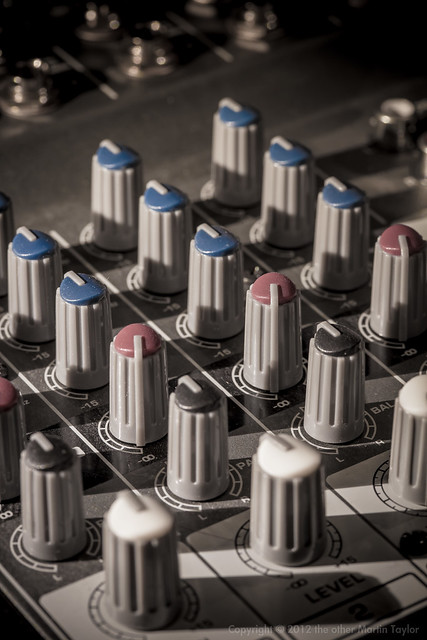
Mixer If you happen to be in to Sony Acid Music Studio (or Pro) you'll know what the 8-Packs are. For the rest of the world the 8-Packs downloads are a song and all the source loops required to created that piece that Sony releases to the world, generally each week. You have one week to download the current 8-Pack and then it's gone forever. With the help of my handy RSS reader I've been religiously downloading the 8-Packs for a year ot more. The loops they contain are valuable. Deconstruction the songs is inspiring. The fact that it's all free, Royalty-free music that you can customize easily yourself makes them invaluable.

However, I've recently been thinking that I should be doing more with each 8-Pack than downloading it to my Acid resource repository on my PC, rendering out an MP3 and then forgetting about it. I should take advantage of these little collections of loops and see what I can come up with using them as opposed to the 'official' song that comes with them. I've done this for the past 2 weeks and I'll try to keep doing it for the next 50. It's a great way to learn how to score for your own movies - even if what I come up with is not as good as what a real musician would make at least I'm learning the techniques and language and that has to be worth something doesn't it?

I've looked around and I'm surprised that no one else is doing this but here are my first two efforts. In the future I'll post a month's worth at once. Of course, if you want to use anything they're all available under the creative commons licence from SoundCloud.

Post-Apocalypse Revisited by the other Martin Taylor

They Rise Again ... Again by the other Martin Taylor

Creative Commons Soundtracks: Part 3

I am having trouble finding much in the way of tutorials for Sony Music Studio. Not that there's a lot out there for the pro version either and what little there is largely works in the consumer version too. Luckily, if you're a Vegas user already, Acid is very intuitive but I thought there'd be a huge fan base especially among semi-musically literate film makers looking for royalty free scores they have control over. I'm still only playing with the looping part of the program but I am trying to find a midi controller keyboard on Craigslist to start playing with that third of the program and I'll look at the audio recording part of the program too. Until then here are my latest creative commons efforts:

Saturday Morning Drive by the other Martin Taylor

Nothin' to be Blue About (Acoustic Blues In E) by the other Martin Taylor

Creative Commons Soundtracks: Part 2

I try to lead a creative life; as much as I can fit in around the wage-slave mundanity of the 9-to-5. Part of that is I allow myself to play and dabble in as many fields as I want. I know the cliche "Jack of all trades, master of none"  may apply to me but I do consider myself a reasonable accomplished photographer. The danger of mastering a craft is feeling stale. I can knock out pictures of a reasonable standard but I've lost a little of that wonder and magic I felt when I first saw a print fading out of the ether in a developing tray, or when I first realized what I could do with my first digital camera and an early version of PhotoShop.

It's a feeling I've rediscovered playing at making soundtrack music. The last time I recorded something was on cassette on a hissy 4-track. Like all arts and crafts, technology has changed all that and lowered the bar to entrance and participation. Instead of having to patch a load of things together with midi cables and bounce down tracks I can now just mess around for a few minutes here and there on my laptop. I'm sure what I'm coming up with is the equivalent of those first Photoshopped pictures I made: cliqued, over-saturated, over-sharpened, amateurish messes but I am having as much fun as a kid with finger paints. And to get past those musical, amateurish messes I first have to make them. Lucky you can even hear my fumblings thanks to SoundCloud which seems to be to music what Flickr is to photography. Just like a newbie on Flickr I am lost in the crowd on SoundCloud and am having a hard time working out how to separate the wheat from the chaff but the novelty is still working in my favor.

Deep Dive Drift by the other Martin Taylor

Wednesday Loopy Blues by the other Martin Taylor

Creative Commons Soundtracks: Theme for the Digerati

Theme for the Digerati (v2) by Martin Taylor
I'm not much of a musician but, like many filmmakers and other content creators, I do sometimes create a soundtrack when I need something specific and I can't find what I need with a creative commons licence (I never use music without having the licence even for the smallest job). It feels a little hypocritical to always be taking others creative work in this field but never putting anything in the pot myself. So, for what it's worth, heres a little something I came up with for the background of a technology video.

Here's an older theme I created for a short architectural rendering video:
WFH Cottage Theme by Martin Taylor

Finally, a short orchestral theme I created with Sony ACID Music Studio just to see if I could create something traditional for a soundtrack if I need to:
Theme For An Imaginary Prairie by Martin Taylor
I might not be a musician but I still like to mess around with my guitars, Sony ACID Music Studio and various iPhone apps.

Using The DIY Mini-Rail Dolly


Last time I described how I made a mini-rail dolly. I finally found a little time to take it out into the backyard and try using it. Here's the result followed by a few tips and tricks for using it:


I couldn't find any real instructions on using a slider so here is what I learned after using my home-brew device once (there should be more authoritative voices than mine out there but I can't find them):

  • Have a planned start and stop point for your move and pre-focus accordingly.
  • If you're rolling into a focus point pre-focus with your camera in the final location and use a finger to mark where that position is on the rails - your finger makers a pretty soft stop point.
  • Don't use the end buffer of the rails as your stop point - the way the camera stops is too sudden. 
  • Give yourself 5 seconds with the camera still at both the start and end points of your move to give yourself more options when you come to edit.
  • Start the movement slowly and end slowly - avoid sudden acceleration and braking.
  • Don't move the camera too quickly - you want to induce a feeling of sophistication not motion sickness.
  • It's really hard to move the camera consistently at a very slow speed.
  • Pulling focus on a DSLR while rolling is very hard - avoid if at all possible.
  • When you're trying to get a smooth move you can hold the sled or head but it seemed to work best for me if I held the camera itself.
  • Objects must be close or mid-distance to work effectively with small movements of 5ft and less
  • Keep your tracks, horizon and horizontal lines level - shim the tracks to achieve this and make sure they don't rock part way through the move as the center of gravity changes.
Again, these are just my personal findings. If you know better I'd love to hear from you.